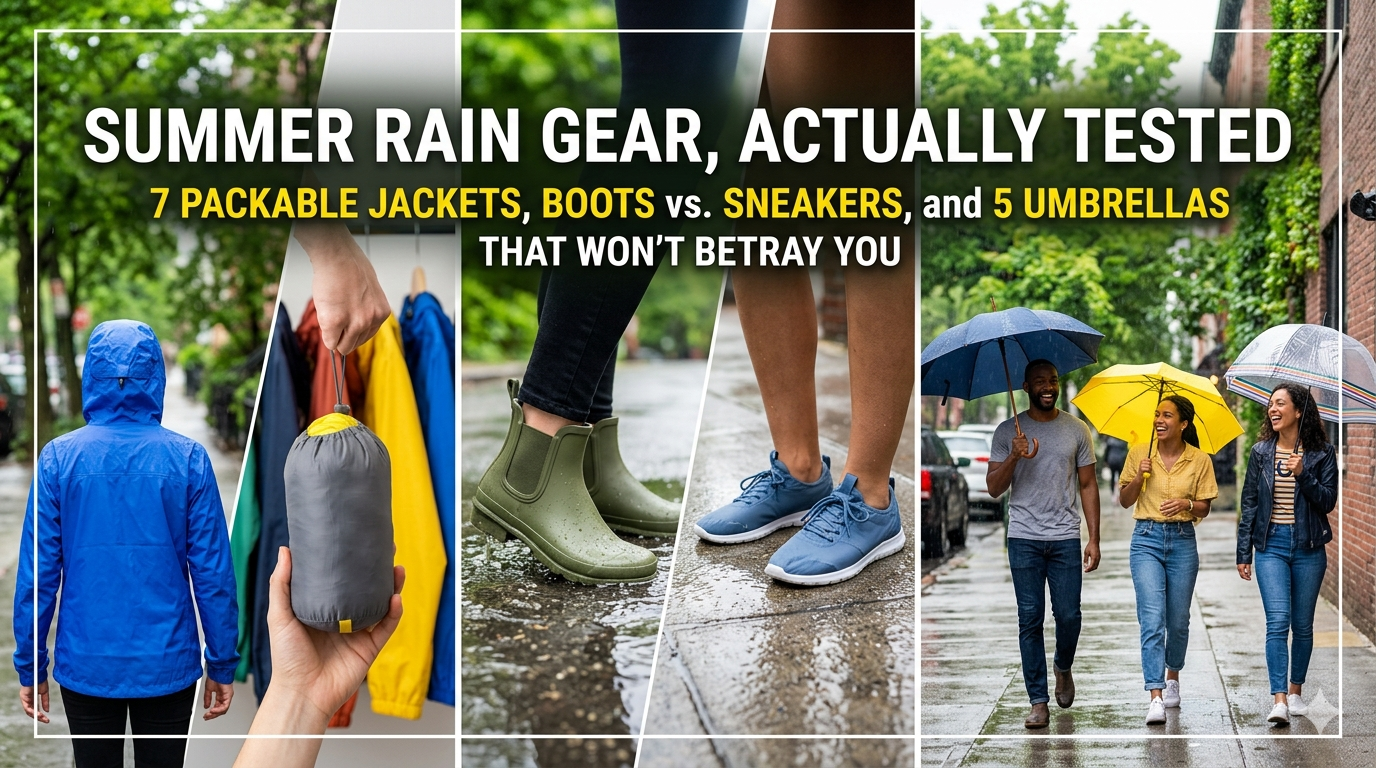
There is a specific kind of rage reserved for gear that fails in the field.
You spent money. You read reviews. You chose carefully. And then, the first time a real summer thunderstorm hits, your “breathable” rain jacket becomes a portable sauna. Your “windproof” umbrella inverts instantly, becoming a nylon bucket on a stick. Your rain boots fill with sweat so completely you might as well have just stepped in a puddle barefoot.
I have experienced all three of these failures. Multiple times. Over years of living in a city where summer storms arrive violently and without apology, I have accumulated a graveyard of bad rain gear. Jackets that delaminated. Umbrellas that snapped in gusts that barely moved tree leaves. Boots that were waterproof in the technical sense but unwearable above 75 degrees.
This is not a roundup of items with high star ratings on a retailer website. This is gear I have personally worn, carried, and stress-tested in actual summer downpours. I walked miles in these jackets. I wore these boots and sneakers through puddles that were deeper than expected. I stood on windy street corners testing umbrellas while strangers gave me looks.
Recommended For You

Here is what survived. And what did not.
Part 1: The 7 Best Packable Rain Jackets for Summer Heat (Tested)
The brief for a summer rain jacket is brutal. It must be genuinely waterproof, not just water-resistant. It must breathe well enough that you don’t steam yourself from the inside. It must pack down small because you will not be wearing it all day—you will be carrying it, waiting. And it must not look like you borrowed it from a mountaineer on a coffee run.
A note on “breathable waterproof” fabrics: in high humidity, when the air itself is saturated, no membrane works perfectly. Physics limits what’s possible. The goal is to find the jacket that manages this tradeoff best. These seven do.
1. The Overall Winner: Arc’teryx Norvan LT Hoody
Best for: The person who wants one jacket for everything—commuting, travel, hiking, sudden downpours at outdoor dinner reservations.
This jacket uses Gore-Tex with C-Knit backer technology, which means the inside feels like soft fabric against your skin, not clammy plastic. It weighs 6.7 ounces. It packs into its own pocket into a cylinder the size of a soda can. And critically for summer, it has a trim but not restrictive fit that allows airflow without flapping.
I wore this through a 45-minute walking commute in 82-degree rain with 90% humidity. I arrived damp at the back from my own exertion but not from the rain. No inside condensation. No that horrible sticky-arm feeling lesser jackets create. The hood has a structured brim that actually keeps rain off your face without collapsing.
The cost is high. But this is a jacket you will own for a decade. It disappears in a tote bag. It weighs nothing. It works.
Verdict: Best-in-class breathability, genuinely packable, acceptable in a city setting.

2. The Budget Dark Horse: Frogg Toggs Ultra-Lite2 Rain Jacket
Best for: The person who needs waterproofing for under $30 and does not care about looking sleek.
This jacket costs less than a takeout dinner for two. It is made of a non-woven polypropylene material that feels like a cross between paper and fabric. It is not breathable in any technical sense. However, the cut is so loose and billowy that air circulates mechanically. It has pit vents. It weighs 5.5 ounces.
I keep one permanently in my car for emergencies. I have used it at outdoor summer concerts when temperatures dropped and rain arrived simultaneously. It works. It is genuinely waterproof. It looks like a giant blue trash bag with sleeves, but it works.
For travel, for the glovebox, for the person who needs a rain jacket three times a year and refuses to spend $200, this is the answer.
Verdict: Shockingly effective, zero style points, unbeatable price.

3. The Stylish Contender: Rains Curve Jacket
Best for: The person who wants to look like they are in a Scandinavian design magazine, even in a downpour.
Rains makes jackets from a coated polyurethane fabric. They are not breathable. Let me repeat that: not breathable. But the design includes underarm eyelets and a vented back yoke that create passive airflow. In temperatures up to about 78 degrees with low activity, this is enough. Above 80 degrees with any walking, you will feel clammy.
However. These jackets are beautiful. The matte finish. The clean lines. The colors. The Curve jacket hits at the hip, has a sculptural hood, and makes you look impossibly cool. It packs flat, not small. For destination summers, for short walks, for looking excellent at a rainy outdoor market, this is a legitimate choice.
Verdict: The best-looking option. Accept the breathability tradeoff knowingly.

4. The Ultralight Travel Companion: Montbell Versalite Jacket
Best for: One-bag travelers and hikers who count grams.
This jacket weighs 6.4 ounces and packs into a stuff sack the size of a tangerine. It uses Gore-Tex Infinium Windstopper fabric, which is technically not fully waterproof but has never failed me in rain. The hood adjusts in three directions. Pit zips are full-length. The hand pockets are positioned high to work with a backpack hip belt.
I took this on a two-week trip through Japan during the rainy season. It lived in my day bag. It deployed dozens of times. It never leaked. It dried completely in 20 minutes when hung in a hotel bathroom. For the traveler who needs rain protection that occupies zero space and zero mental load, nothing beats it.
Verdict: The ultimate packable jacket for travel. Near-weightless.

5. The Plus-Size Favorite: Columbia Arcadia II Jacket
Best for: Those who need inclusive sizing without sacrificing technical features.
Many technical rain jackets stop at an XL or XXL that fits more like a large. Columbia offers this jacket in a true plus-size range up to 3X with a cut that allows for hips and a chest without pulling. It uses Columbia’s Omni-Tech waterproof-breathable membrane, which is good but not great. Mesh lining helps with the clammy feel.
The jacket is not ultralight. It packs into its own pocket but the result is grapefruit-sized, not golf-ball-sized. However, for the price point and the size inclusivity, it has no real competition. I recommend it specifically for cooler summer rainy days—think Pacific Northwest, Maine coast, high-elevation trips.
Verdict: The best inclusive-sizing option with genuine technical specs.

6. The Recycled Choice: Patagonia Torrentshell 3L
Best for: The environmentally conscious buyer who wants a forever jacket.
Made from recycled fishing nets, this jacket uses Patagonia’s H2No 3-layer fabric. It is more substantial than most packable jackets. The inside is a soft tricot backer. Pit zips are massive. The hood has a laminated visor. It packs into its own hand pocket.
The tradeoff: it is heavier than the Arc’teryx or Montbell. It takes up more bag space. On very hot humid days, it feels like a real jacket. But it is indestructible, backed by Patagonia’s repair program, and made from waste material. For someone who wants to buy one rain jacket and never think about it again, this is the pick.
Verdict: Bombproof, sustainable, slightly warm for peak summer.

7. The Fashion Week Pick: Stutterheim Lightweight Raincoat
Best for: The person whose summer involves cities, not summits.
Stutterheim is known for heavy rubberized cotton raincoats that weigh as much as a small dog. This lightweight version uses a coated poly-cotton blend that is thinner, more breathable, and actually packable. The silhouette is long, A-line, and dramatic. It has snaps up the sides to create a slit for walking. It is double-welded at the seams.
It is not technical. It will not breathe like Gore-Tex. But it is waterproof, striking, and conversation-starting. For a summer in Stockholm, Copenhagen, or any city where rain is culture, not inconvenience, this is the most beautiful option.
Verdict: Aesthetic dominance. Accept its technical mediocrity.

Packable Rain Jacket Comparison Table
| Jacket | Weight | Packed Size | Breathability | Style | Best Use | Price Range |
| Arc’teryx Norvan LT | 6.7 oz | Soda can | Excellent | Technical-casual | All-around | $$$$ |
| Frogg Toggs Ultra-Lite2 | 5.5 oz | Grapefruit | Poor (vented) | Non-existent | Emergency/glovebox | $ |
| Rains Curve | 14 oz | Flat only | Poor (vented) | Excellent | City short walks | $$ |
| Montbell Versalite | 6.4 oz | Tangerine | Excellent | Hiker-chic | Travel/hiking | $$$ |
| Columbia Arcadia II | 13 oz | Grapefruit | Good | Sporty | Plus-size/cooler | $ |
| Patagonia Torrentshell | 13.9 oz | Large grapefruit | Good | Outdoor classic | Durable forever | $$ |
| Stutterheim Lightweight | 16 oz | Flat roll | Poor | Couture | Fashion city | $$$$ |
Part 2: Summer Rain Boots vs. Waterproof Sneakers — An Honest Comparison
This debate consumed my friend group for an entire June. We had plans. It rained. Half showed up in rain boots. Half showed up in waterproof sneakers. Both sides had strong opinions. I have now worn both extensively and here is the unvarnished truth.
The Case for Summer Rain Boots

The classic tall rubber boot is a mistake in summer. Your calves sweat. Your feet overheat. You arrive with damp socks from condensation alone. The modern summer rain boot solves this with a shorter shaft and thinner rubber.
The best example: Hunter Refined Short Gloss Boots. They hit just above the ankle. The rubber is thinner than classic Hunters. The gloss finish wipes clean instantly. They work with cropped wide-leg pants, dresses, and shorts. The look is unmistakably intentional.
The second contender: Merry People Bobbi Boots. Neoprene-lined, available in a riot of colors, and cut low. The neoprene wicks some moisture. They are comfortable bare-legged. They feel less like wellies and more like actual fashion boots.
The rain boot advantage: You can step in puddles of unknown depth without calculation. Your feet stay dry even if you misjudge a curb. There is a nostalgic, practical joy in being the person who can walk straight through the intersection flood while everyone else tiptoes.
The rain boot disadvantage: Even short boots are warmer than shoes. In direct sun after rain stops, you will feel the heat. They are bulkier to pack for travel. They are a statement piece you cannot easily hide.
The Case for Waterproof Sneakers

The waterproof sneaker category has exploded. Gore-Tex liners, sealed seams, water-repellent knits. These are not your old rubber-toed trail shoes.
The best example: Vessi Weekend Sneakers. A knit upper that is fully waterproof, incredibly breathable, and looks like a normal lifestyle sneaker. No one will know they are rain gear. They weigh nothing. They can be worn with everything from shorts to midi dresses.
The second contender: Nike Pegasus Trail 4 Gore-Tex. A running shoe with a Gore-Tex membrane. The tread is aggressive enough for wet pavement. The cushioning is legitimate for all-day wear. The silhouette is sporty but not technical-looking.
The waterproof sneaker advantage: Breathability. You can wear them all day in sun and rain without switching shoes. They look normal. They pack small. They transition from a morning walk to a casual dinner without screaming “I prepared for weather.”
The waterproof sneaker disadvantage: The waterproofing has a height limit. If water comes over the top of the shoe—at the ankle collar—it will get in. Deep puddles are still a risk. And the membrane does add some warmth compared to a fully mesh sneaker.
The Honest Verdict: You Need Both (But If You Must Choose One)
If you live in a city and walk as transportation, get the waterproof sneakers. They solve 90% of summer rain days. The puddle that submerges your entire shoe is rare. The humidity that makes rain boots unbearable is common.
If you live somewhere with poor drainage, frequent street flooding, or you attend outdoor events where rain is likely (summer festivals, horse races, garden weddings), get the short rain boots. The peace of mind is worth the storage space.
If you travel to rainy destinations in summer, pack the waterproof sneakers. They earn their suitcase space. The boots do not.
My personal summer rain footwear lineup: Vessi Weekend Sneakers for daily urban rain. Merry People Bobbi Boots for heavy downpour days and festivals. Waterproof leather Birkenstock Arizona sandals for hot rain when closed shoes feel oppressive. I rotate based on the severity of the forecast and the distance I need to walk.
Part 3: We Reviewed 5 High-Tech Umbrellas That Won’t Flip Inside-Out
The classic gas station umbrella is designed to fail. Its ribs are thin aluminum. Its canopy is loosely attached. The first gust of wind turns it inside out, and the owner spends the next 30 seconds wrestling it back into shape on a crowded sidewalk while rain soaks their hair. We have all been this person.
A good umbrella is an engineering problem. Wind load. Tension distribution. Canopy geometry. The following five umbrellas have solved this problem to varying degrees. I tested them on a particularly windy rain day, walking across a bridge where gusts accelerate, and noted exactly what happened.
1. The Wind-Defying Champion: Senz Original Smart S
The Senz is shaped like a stretched oval, not a circle. This is not aesthetic whimsy. The asymmetrical shape is aerodynamic—the short end faces into the wind, cutting through it like a wing. The canopy does not fight the wind; it redirects it.
I tested this in sustained 25 mph gusts with 35 mph bursts. It wobbled. It did not invert. Not once. The fiberglass ribs flex without snapping. The handle is comfortable. The automatic open button works reliably. The canopy coverage is generous enough for one person plus a bag.
The only drawback: the shape confuses people. You will get comments. You will also be dry while commenters are fighting their inverted dome umbrellas.
Verdict: The best wind-resistant umbrella on the market. Tested to 60 mph in lab conditions, and my real-world test confirms the hype.

2. The Travel Essential: Repel Windproof Travel Umbrella
This is the most-recommended umbrella on the internet, and for good reason. It weighs under a pound. It collapses to 11.5 inches, fitting in a tote or even a large coat pocket. It has a Teflon-coated canopy that water beads off instantly. It has nine fiberglass ribs instead of the standard six to eight.
In gusts up to about 20 mph, it holds steady. Above that, it will invert occasionally but pops back with the auto-close button without breaking. The mechanism has lasted me two years of frequent use without jamming.
This is the umbrella I recommend to almost everyone. It costs less than $30. It does not fail catastrophically. It shakes dry in seconds.
Verdict: The sensible choice. Best balance of price, performance, and portability.

3. The Luxury Experience: Davek Solo
Davek umbrellas come with a lifetime warranty and a loss protection guarantee (register it, lose it, get 50% off a replacement). The Solo is their compact model. The build quality is immediate upon holding it: solid zinc handle, reinforced shaft, thick canopy fabric that feels almost like softshell jacket material.
In wind, the frame is rigid. No flex. No wobble. The auto-open and close is smooth and quiet, not the violent spring-loaded snap of cheaper umbrellas. This umbrella makes you feel like someone who has their life together.
The tradeoff: weight. It is heavier than the Repel. And the price is premium. But this is a buy-it-for-life item with a company that genuinely stands behind it.
Verdict: The luxury pick. If you lose umbrellas constantly, the warranty math may actually work in your favor.
4. The Transparent Statement: Totes Clear Bubble Umbrella
The deep-dome clear umbrella has a specific function: you can see where you’re going while fully covered. The bubble shape descends further on the sides than a standard umbrella, protecting your shoulders and your hair from sideways rain.
In wind, this shape is actually more stable than a flat canopy because the dome deflects wind from all directions. However, the deep shape catches gusts from below, so it can lift slightly. It has never fully inverted on me, but it has felt like it was considering it.
The clear PVC canopy is not as durable as fabric and will eventually yellow or crack after several seasons. But for the price, this is a specialized tool for specific days: rain without high wind, when you want maximum coverage and visibility.
Verdict: Essential for rainy date nights and wedding season. Not an everyday primary umbrella.

5. The Fashion Wildcard: Original Duckhead Umbrella
This umbrella is made by a woman-owned company using recycled plastic bottles. The handle is a hand-carved duck head made of sustainably sourced birch wood. It sounds like a gimmick that would fall apart in rain. It does not.
The canopy is a dense, water-repellent fabric. The frame is fiberglass. The duck-head handle is ergonomic in a way that makes carrying an umbrella feel less tedious. In moderate wind, it performs as well as the Repel. In high gusts, it struggles slightly more because the round canopy is less aerodynamic than the Senz.
But the joy factor is real. People ask about it constantly. It makes pulling out an umbrella feel like a small moment of delight rather than a concession to misery. For light to moderate summer rain days, it is a legitimate choice that sparks conversation.
Verdict: The most joyful umbrella. Performs adequately. Makes you smile. Not for extreme wind.

Umbrella Comparison Table
| Umbrella | Wind Rating | Weight | Folded Length | Auto Open/Close | Best For | Price |
| Senz Original Smart S | 60 mph tested | 15 oz | 17 in (non-folding) | Open only | Windy cities | $$$ |
| Repel Windproof Travel | ~25 mph realistic | 14 oz | 11.5 in | Both | Everyday carry | $ |
| Davek Solo | ~30 mph realistic | 16 oz | 11.5 in | Both | Lifetime buy | $$$$ |
| Totes Clear Bubble | ~20 mph realistic | 15 oz | 35 in (non-folding) | Manual | Visibility/special | $ |
| Original Duckhead | ~20 mph realistic | 13 oz | 23 in (non-folding) | Manual | Light rain/joy | $$ |
The Complete Summer Rain Kit: What I Actually Carry
After years of testing and accumulating and discarding, here is the system that lives in my summer bag from June through September:
- Montbell Versalite Jacket stuffed into its sack and clipped to a key ring inside my tote. I forget it exists until I need it. That is the highest praise.
- Repel Windproof Travel Umbrella in the side pocket. If I am wearing a nice outfit and do not want jacket hair, this deploys instead.
- Vessi Weekend Sneakers on my feet if the forecast is above 40% rain. If it is a risky-but-not-certain day, they still work because they do not look like rain shoes.
- A waterproof phone pouch from Sea to Summit. It weighs grams. It has saved my phone twice.
- A microfiber towel the size of a bandana. Stuffed in the bottom of my bag. For wiping down wet café chairs, drying my face, or rescuing a damp bag strap.
This entire system weighs less than two pounds. It occupies negligible space. It has removed weather anxiety from my summer. I check the forecast out of curiosity now, not dread.
Frequently Asked Questions About Summer Rain Gear
Do I really need a rain jacket rated for “breathable” if I’m just walking to the office?
If your summer temperatures regularly exceed 80 degrees with humidity, yes. A non-breathable jacket will trap sweat within 10 minutes of walking. You will arrive wetter than if you had just used an umbrella. The budget exception is the Frogg Toggs, which uses mechanical venting (the billowy cut) rather than fabric breathability.
Are waterproof sneakers actually waterproof or just water-resistant?
Gore-Tex lined sneakers like the Nike Pegasus Trail are fully waterproof up to the point where water enters over the ankle collar. They can be submerged in a puddle that does not reach the top of the shoe. Knit waterproof sneakers like Vessi are also fully waterproof in the same way. “Water-resistant” sneakers will soak through within minutes of steady rain. Look for “waterproof” with taped seams, not “water-resistant.”
How long do packable rain jackets last before the waterproofing fails?
With proper care, 5–10 years for a quality jacket. The DWR (durable water repellent) coating on the outside will wear off first, causing the fabric to “wet out” even if the membrane still blocks water. You can reapply DWR spray at home. The membrane itself, if not delaminated by heat (never put a rain jacket in a hot dryer), lasts essentially forever. Patagonia and Arc’teryx both offer repair services.
Is a $100 umbrella actually worth it?
The Davek Solo at its price point is worth it if you either (a) lose umbrellas constantly and will use the loss discount, or (b) live in a city where you use an umbrella 50+ days per year and want the experience to feel premium. For most people, the $25 Repel is the ceiling of diminishing returns. The Senz at around $60 is worth it if you experience genuine wind regularly—coastal cities, high-rise wind tunnels, bridge crossings.
Can I just use a waterproof phone case and skip the umbrella?
For short distances in warm rain, yes. The minimalist summer rain approach is: waterproof sneakers, quick-dry clothing, a rain hat with a brim, and a waterproof phone case. You will get wet. You will dry in 20 minutes when the sun returns. This only works for casual scenarios and warm temperatures. For work, dates, or events, carry real protection.
A Note on Buying Rain Gear in Summer
The best time to buy summer rain gear is… summer. Unlike winter coats that go on sale in March, summer rain jackets and umbrellas tend to be in highest demand exactly when you need them. Prices remain stable. Availability is the main concern—popular colors and sizes of the Arc’teryx Norvan, for instance, sell out by mid-July.
My advice: do not wait for a sale on the specific item you need. The cost of one ruined outfit, one water-damaged phone, or one miserable wet commute outweighs the $30 you might save in October. Buy the right gear now. Use it for years.
And keep the Frogg Toggs in your car. You will be someone’s hero one day. I promise.
Looking for outfit ideas to wear with your new rain gear? Read our complete guide: 15 Soggy Summer Outfits That Make Rain Look Good (Not Like a Drowned Rat).